Showing posts with label wildlife. Show all posts

Friday, July 22, 2011

Owls and Toads

Just sharing a couple fun wildlife sightings during a busy field day!


juvenile (left) and adult (right) burrowing owls (Athene cunicularia)


a Great Basin spadefoot toad (Spea intermontana) metamorph poses on my SAVE THE FROGS! bracelet

Sunday, May 1, 2011

Sierra Nevada Bighorn Sheep Recovery

This past week I attended the Sierra Nevada Bighorn Sheep Recovery Implementation Team meeting in Sacramento. The team is composed of biologists, researchers, and land managers with responsibilities affecting recovery of the endangered species. I learned a lot and it was humbling to be in a room with so many experts in the field.


Inspired by the meeting, I took a hike up into Pine Creek Canyon where I heard that bighorns had been seen at lower elevations. On the way back down from the mill, we spooked a group of nine Sierra Nevada bighorns: three rams, three ewes, and three young. After scrambling a ways up a cliff face, the sheep felt safe enough to allow us to watch them while they fed. It was an amazing encounter with this highly endangered species.

Tuesday, April 12, 2011

Rare East Side Salamanders

Two salamander species are found in the Bishop BLM Field Office jurisdiction: Hydromantes platycephalus (Mount Lyell salamander) and Batrachoseps campi (Inyo Mountains slender salamander). Both species are California Species of Special Concern and B. campi is a BLM Sensitive Species.

Hydromantes platycephalus was discovered accidentally in 1915 in pitfall traps set to survey mammals on Mt. Lyell in Yosemite. Salamanders in the southern portion of the range in Long and Owens Valleys were believed to be a different species but were recently shown to be the same (Rovito 2010). Found from 4,000 to 12,000 feet, a couple individuals have been located on BLM lands. I am yet to find one, but hope to by resurveying the locations.

Batrachoseps campi wasn't discovered until 1973 and is only known from 16 canyons and springs in the Inyo Mountains. The canyons are difficult to survey, with steep, rocky waterfalls I had a hard time getting up. Fortunately, at one location I found an individual beneath a rock at the foot of a steep face. Nothing like locating a rare salamander to make a biologist's day!

heading up the wash
success!

Rovito, S. 2010. Lineage divergence and speciation in the Web-toed Salamanders (Plethodontidae: Hydromantes) of the Sierra Nevada, California. Molecular Ecology 19: 4554-4571. (pdf)

Greater Sage-grouse Lek Surveys

It's that time of year! The snow has melted off the meadows, so the Greater Sage-grouse (Centrocercus urophasianus) are gathering at their traditional lek sites in Long Valley and Bodie. The hens initially come for a bite to eat, but the males are soon attempting to outdo each other for attention. It's quite a sight to see!

In cooperation with the California Department of Fish and Game, the Los Angeles Department of Water and Power, and the U.S. Forest Service, we're able to conduct "saturation counts," with at least one person surveying each lek. Because the birds can move between them, this gives us a fairly accurate estimate of their population. We're able to count each lek using a spotting scope from a distance away so we can view the entire area and not disturb the birds.

If you can't get over to the east side to see this amazing display, here is a video clip from the Montana NRCS website.

view of strutting males through a spotting scope
two males displaying at "Long Valley lek 9"

Thursday, January 20, 2011

Small Mammal Trapping at Fish Slough

Not knowing much about what small mammals are present in Fish Slough, I set out some Sherman live traps to see what I could get. It has been demonstrated that 84% of the species present in an area can be captured over the first three trap nights, but a fourth night only increases the estimate by 2%, so I left the traps out for three nights and two days. Since the weather isn't very hot during the day this time of year, I left the traps open during the days as well as nights. The traps were baited with peanut butter and oats and cotton balls were provided for bedding.

I ended up capturing 10 individuals of 4 species: Sorex vagrans (vagrant shrew, 2), Microtus montanus (montane vole, 1), Reithrodontomys megalotis (western harvest mouse, 3), and Peromyscus maniculatus (deer mouse, 4). Not a bad selection for the middle of winter! The shrews were a particular surprise, since they're not often captured in box-style traps.


Sherman trap

Sorex vagrans

Microtus montanus

Reithrodontomys megalotis

Peromyscus maniculatus

cute mousey face

Friday, January 7, 2011

Midwinter Bald Eagle Count

Today we helped cover some survey routes for the Midwinter Bald Eagle Count, a national effort currently coordinated by the U.S. Army Corps of Engineers. The 2 feet of snow along one of our three routes turned what we expected to be an easy drive into an unexpected 6-mile hike through the snow, but it beats sitting at a desk all day! We ended up seeing two striking adult bald eagles and one juvenile.


There's one! Adult bald eagle at Tinemaha Reservoir viewed through a spotting scope

cool rodent tracks in the snow

Tuesday, December 14, 2010

Guzzlerpalooza

Wildlife guzzlers collect water so it's available to wildlife in arid areas. They are normally installed to attract and increase game species, but all wildlife benefits. A number of different designs have been utilized through the years, making maintainance interesting.


an original "walk-in" design, with its apron covered in snow; these guzzlers are being converted to prevent unintended issues of animals becoming trapped in the tank


this walk-in (installed in 1966!) has been converted, with a drinker installed below (not in the photo)


this photo shows a typical drinker, installed below "flying saucer" collectors

looking down on the "flying saucers" and me hard at work!


yet another design, this one simply collects water on the top that funnels into the tank

Tuesday, November 16, 2010

Bonus Jackrabbit!

While we were letting down fences in the Bodie Hills today, we came across a new species for me, the white-tailed jackrabbit (Lepus townsendii townsendii). Considered a pest by many farmers in the Midwest, they have a limited distribution in California, associated with sagebrush habitats and considered a State Species of Special Concern. Like snowshoe hares (Lepus americanus), their fur is brown in the summer and white in the winter. It looks like we caught this one somewhere in the middle.

Despite the name, the white-tailed jackrabbit is a true hare. Remember the differences? Hares are generally larger and faster than rabbits, with larger ears and feet. Their young are born precocial, with fur and able to see. In contrast, the young of rabbits are born altricial, blind and hairless. But both are lagomorphs, not rodents.

Always exciting to find a species I haven't seen before!

Friday, November 12, 2010

Grouse Trapping

Last weekend I had the opportunity to assist the crew of a USGS researcher trapping Greater Sage-Grouse (Centrocercus urophasianus) in the Virginia Mountains north of Reno, NV. Two nights previously, they saw 80 grouse, but by the night I was there we only saw 6. Slightly disappointing, but at the same time it was exciting to be in the middle of their transition to winter range. A Nevada Department of Wildlife employee is going to be flying the area to find out where the grouse actually spend their winter, one of the things that this study will tell us.

So how do we trap the grouse anyway? Honestly it's one of the more bizarre wildlife-trapping methods I've experienced. We worked in teams of two. I had the relatively simple job of following the team leader through sagebrush by headlamp, carrying a long-handled net. He did everything else. Using binoculars and a spotlight, he scanned the area to try and catch eyeshine from the grouse. As we snuck closer, he would spotlight the bird and turn on a speaker hooked up to a radio tuned to static. The grouse will flush at the sound of footsteps (walk without rythym...), so any loud noise disguises our steps and keeps the poor bird disoriented. My boss says they used to use chainsaw motors, and some people play music, although the regular beat in songs may not be as successful as noise. Many people use three person teams, with two netters behind the spotlighter. We only needed two because we had a pretty slick net gun. The leader shot the net over the bird, then I followed in to put the long-handled net over it to keep it from escaping.

Normally they take a lot of measurements on the bird, but the focus was to get radio collars on as many birds as possible before the winter. We took pictures and some blood, but the rest of the measurements will be taken when the birds are recaptured next year. We were only able to catch one bird that night, but I'm glad I had the opportunity to do so!

Monday, October 4, 2010

Southwestern Desert Bats Class

This past weekend I attended a Southwestern Desert Bats Class taught by Dr. Pat Brown. The class took place at the Desert Studies Center in Zzyzx, CA on the northern edge of the Mojave National Preserve. We learned a lot about bat biology, identification, echolocation, survey methods, and conservation. We spent an evening mist-netting along Salt Creek and captured three species: western parastrelle or canyon bat (Parastrellus hesperus), California myotis (Myotis californicus), and pallid bat (Antrozous pallidus). We also spent some time with other desert creatures. A very informative class in a wonderful location! I highly recommend it.

A Key to California Bats (pdf) provided at the class


Parastrellus hesperus


Antrozous pallidus

scorpion under blacklight


baby scorpion on a dime

I love the DSC!

Tuesday, September 28, 2010

Bat Exclusions

Abandoned mines can be hazards to human health and safety as well as essential maternity and hibernation habitat for bat species. Balancing these two issues can be a challenge. With the expertise of Dr. Pat Brown, we're able to plan mine closures that keep people safe and maintain habitat for the bats. Bat gates are installed on addits and shafts with larger numbers of bats. Some mine features don't appear to have any bats using them, and we're able to "hard close" the portals. They're either filled with rocks and dirt or polyurethane foam (PUF). To prevent any bats from being trapped inside, we first exclude them by covering the portals with chicken wire after any fly out. Bats are able to crawl out through the chicken wire if we miss them, but are unwilling to put in the effort to crawl back in and will find another hole that won't be closed. However, we need to finish the hard closures before hibernation season, since that's a good enough reason for the bats to make the effort to re-enter. Timing is everything!


excluded shaft


unrolling the exclusion


mounting a large exclusion

night sky through IR goggles

Sunday, September 26, 2010

Grouse Tracks!

Sage-grouse tracks in Long Valley's sandy soil.
I love their chicken-dino-feet!

Tuesday, August 31, 2010

More Pygmy Rabbits

We went back to the pygmy rabbit site to set up the camera by some burrows that are dug beneath a large metal plate with a tire on top. Not your typical habitat! This time we got photos of cottontails as well as pygmy rabbits, a good comparison! I apologize for the low quality of the scans. The Trailmaster works really well, but it only connects to a film camera!


a cottontail showing off its cottony tail


a cottontail side view


a pygmy rabbit, making sure the trigger goes off


pygmy spaz!

Thursday, August 19, 2010

Moth Mystery...Solved!

Today I came across an awesome moth on a basin big sagebrush (Artemisia tridentata ssp. tridentata). I wish I knew more about moths...I seem to always think I'm seeing a tiger moth (family Arctiidae), but they never actually turn out to be one. I wasn't sure if the sagebrush was significant in this case, but it turns out that it was! As far as I can tell (thank you, internets), it's Hemileuca hera (family Saturniidae, wild silk moths), the Hera buckmoth or sagebrush sheep moth. They are indeed active during the day, and I may have disturbed her laying her eggs on the sagebrush. I'm sure she had no problem finding another shrub to lay her eggs on. They'll overwinter and hatch next April-June...and will look like a photo of a caterpillar I had in a previous post! I guess I've come full circle (or is it full life-cycle?) on Hemileuca hera!

Hemileuca hera on Artemisia tridentata ssp. tridentata

I love this orange, fuzzy face!
I believe this caterpillar I previously observed is Hemileuca hera

Wednesday, August 18, 2010

California Greater Sage-grouse Hunt is On

According to Audubon California, the California Fish & Game Commission voted today to allow hunting for Greater Sage-grouse in the North Lassen, North Mono, and South Mono hunting zones. No permits will be given for Central Lassen County. The quota for the Mono zones is 1 per day; 1 per season.

Permit applications were already due to Fish & Game. The general hunting season is September 11 & 12, 2010. The falconry season is November 7, 2010 through January 5, 2011.

Sunday, August 15, 2010

Troubles with Technology

I was super excited to find out that we had a Pettersson bat detector and the corresponding SonoBat software. With it, I can record bat calls and compare them to reference files to find out what bat species are emerging from abandoned mines or using ponds for foraging and drinking. I took it out to another outflight count that Joy and I conducted on thursday evening.


mine entrance with bat gate


detector ready to record

This is how calls of Townsend's big-eared bats (Corynorhinus townsendii) should appear.

This is what I got. Argh!

Apparently the detector was picking up noise when it triggered. It wasn't doing that when I tested it in the office beforehand, so I'll have to see if I can figure out the problem. Never a dull moment!

Friday, August 6, 2010

Bat Maternity Colony Outflight Count

On Thursday night, Joy and I were joined by Dr. Pat Brown and her associate to conduct an outflight count of a Townsend's big-eared bat (Corynorhinus townsendii) maternity colony in an abandoned mine. Our western subspecies (C. t. townsendii) is the closest we have to a formally endangered bat in California, although bats are starting to get more attention, particularly since the outbreak of White-Nose Syndrome in the eastern US in 2006. Townsend's big-eared bats were previously considered a Category 2 candidate species by the Fish & Wildlife Service, though the term is no longer in use. They are now considered a Federal Species of Concern, along with a California Species of Special Concern, and BLM Sensitive Species in California. None of those designations packs a whole lot of punch, but at least people are paying some attention. While we do have to close mines to protect human health and safety, we do take the bats into consideration and use bat-friendly structures whenever possible.

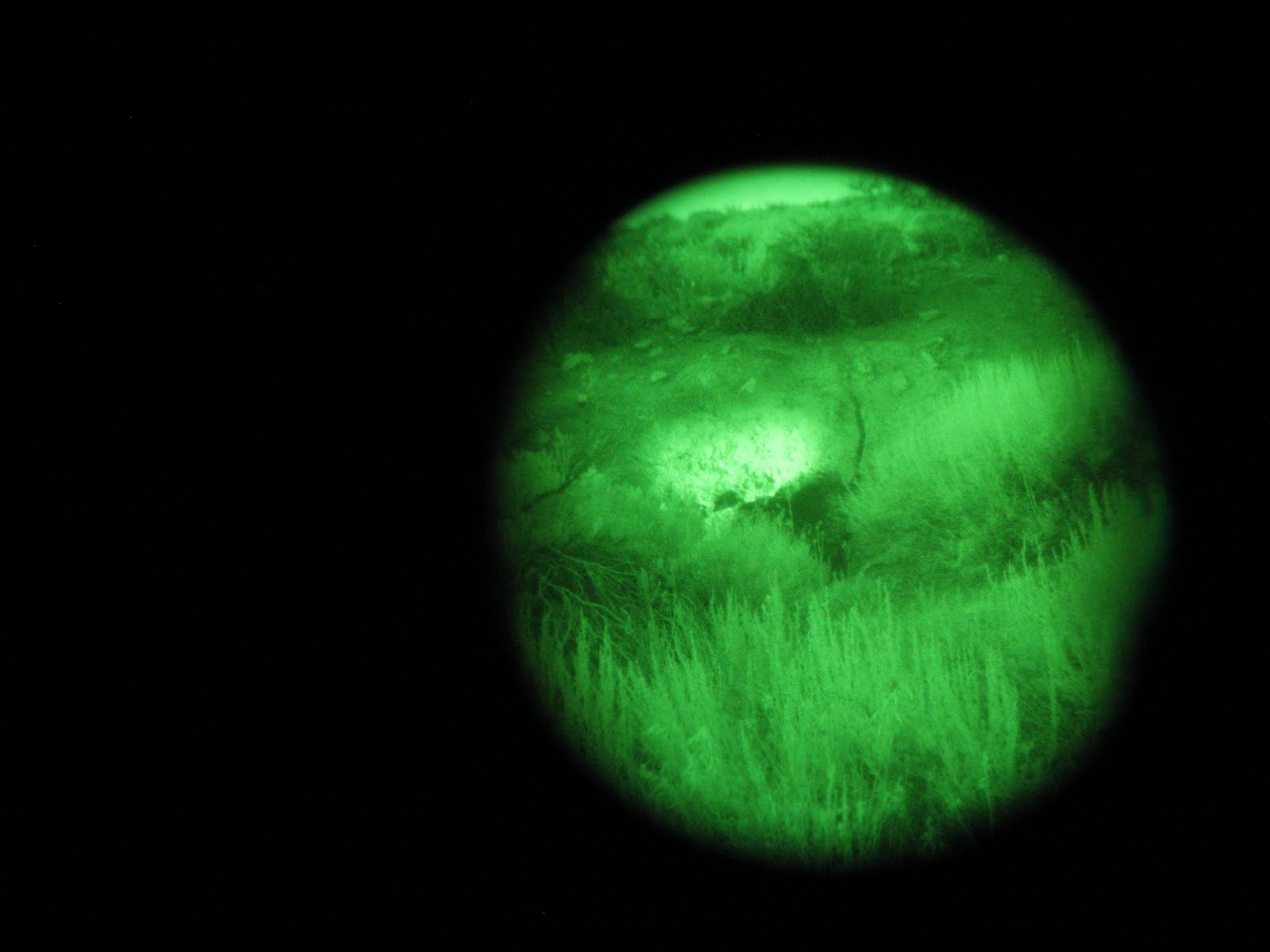
To conduct an outflight count, we position ourselves in front of each mine opening. We use an infrared light pointed towards the mine entrance and watch with night vision goggles. I have to say it feels pretty surreal to be up in some random mountains, waiting in silence with black ops gear, but it was one of my coolest experiences on the job so far. I could hear the bats' wings as they flew by my head and out into the night. Between the four of us, we ended up counting over 200 bats flying out. I had 49 from my entrance. At this time of year, this includes the babies as well as the mothers. Dr. Pat says that this is the largest Townsend's maternity colony she knows about in California.

ready to count with my night vision goggles and counter; we use two counters, one for "out" and one for "in"

okay picture through one eye of the night vision goggles, showing the infrared light illuminating the mine entrance

Townsend's big-eared bat species account by the Western Bat Working Group (pdf)

Wednesday, August 4, 2010

More Than Poo

Today we went all over the Bodie Hills, looking at various current and prospective projects. It was also my best day for wildlife viewing yet! I wish I had my nice camera, but hopefully these will at least give you a taste:

momma sage-grouse and her brood demonstrating a wildlife-friendly fence along Bodie Creek

mule deer doe
(Odocoileus hemionus)

distant pronghorn antelope (Antilocapra americana)

the group contained 13 females and 1 male
Special thanks to my boss, Steve, for sneaking up on the grouse in our F150 and to Casey for actually taking the shot since I was ensconced in the back seat.

Tuesday, July 27, 2010

Here There Be Grouse

When they're not strutting around the lekking grounds, sage-grouse can be difficult to find. Fortunately, they leave sign behind so we can tell if they've been using an area.

Winter scat is composed entirely of sagebrush leaves and, in keeping with the theme of food descriptions of scat, has been described as shaped like a Cheeto. The leaves of sagebrush are covered in glands that contain monoterpenes and sesquiterpine lactones. Whew ! The chemicals likely deter herbivory from most species. The monoterpenes give sagebrush its characteristic smell. The sesquiterpene lactones are indigestible to sage-grouse and are excreted in pasty, black cecal tar. Both types are shown in the photo below.

grouse sign

a cool caterpillar

Greater Sage-grouse Field Indicator Guide (pdf via ftp)

For (lots) more on sagebrush and its role in sage-grouse diet: