Showing posts with label bats. Show all posts

Saturday, October 23, 2010

Racing the Seasons...

I'm sorry I haven't done much in the way of updates lately, but we've been busy trying to finish up projects before winter weather shuts us out of parts of our resource area.

Remember those headcuts in Aurora Canyon? We've been working on some of the smaller ones, simply filling them with rock or concocting more intricate structures with erosion cloth and logs. The idea is that the structures will both slow the water down and collect sediment to bring the level of the drainage back up.


log check dams over cloth

filling with rock

Another project we're working on is an abandoned mine closure at a mine where Townsend's big-eared bats (Corynorhinus townsendii) hibernate. Some features will receive bat-compatible gates while others will be permanently closed. We need to get the work done before the hibernating bats arrive to prevent disturbing them.

This adit held the powder magazine. The bat gate will be behind the door to preserve the historic feel of the site.


The main mine entrance has wooden cribbing supporting the portal. The bat gate will have to be located farther back in stable rock.


This vertical shaft, not far from a road, will be closed. A false bottom will be created using polyurethane foam (PUF), then the hole will be filled with surrounding material.


Warm air escapes through this shaft at the top of the mine, pulling cold air into a north-facing adit below, creating perfect hibernation conditions for bats. A metal cupola will be built over the top, preventing access, protecting the existing historic structures, and allowing bats to fly out.

Other species are feeling the chill as well. This Great Basin gopher snake (Pituophis catenifer deserticola) was all stretched out on Fish Slough Road, soaking in some warmth. Despite the fact that I swerved around him on the road, he wasn't very happy when we went to check on him. He puffed up with air, hissed loudly, and vibrated his tail in his best rattlesnake impression. Sorry buddy, you can't fool us! You're welcome for not running you over though. =P

Winter is coming...

Monday, October 4, 2010

Southwestern Desert Bats Class

This past weekend I attended a Southwestern Desert Bats Class taught by Dr. Pat Brown. The class took place at the Desert Studies Center in Zzyzx, CA on the northern edge of the Mojave National Preserve. We learned a lot about bat biology, identification, echolocation, survey methods, and conservation. We spent an evening mist-netting along Salt Creek and captured three species: western parastrelle or canyon bat (Parastrellus hesperus), California myotis (Myotis californicus), and pallid bat (Antrozous pallidus). We also spent some time with other desert creatures. A very informative class in a wonderful location! I highly recommend it.

A Key to California Bats (pdf) provided at the class


Parastrellus hesperus


Antrozous pallidus

scorpion under blacklight


baby scorpion on a dime

I love the DSC!

Tuesday, September 28, 2010

Bat Exclusions

Abandoned mines can be hazards to human health and safety as well as essential maternity and hibernation habitat for bat species. Balancing these two issues can be a challenge. With the expertise of Dr. Pat Brown, we're able to plan mine closures that keep people safe and maintain habitat for the bats. Bat gates are installed on addits and shafts with larger numbers of bats. Some mine features don't appear to have any bats using them, and we're able to "hard close" the portals. They're either filled with rocks and dirt or polyurethane foam (PUF). To prevent any bats from being trapped inside, we first exclude them by covering the portals with chicken wire after any fly out. Bats are able to crawl out through the chicken wire if we miss them, but are unwilling to put in the effort to crawl back in and will find another hole that won't be closed. However, we need to finish the hard closures before hibernation season, since that's a good enough reason for the bats to make the effort to re-enter. Timing is everything!


excluded shaft


unrolling the exclusion


mounting a large exclusion

night sky through IR goggles

Sunday, August 15, 2010

Troubles with Technology

I was super excited to find out that we had a Pettersson bat detector and the corresponding SonoBat software. With it, I can record bat calls and compare them to reference files to find out what bat species are emerging from abandoned mines or using ponds for foraging and drinking. I took it out to another outflight count that Joy and I conducted on thursday evening.


mine entrance with bat gate


detector ready to record

This is how calls of Townsend's big-eared bats (Corynorhinus townsendii) should appear.

This is what I got. Argh!

Apparently the detector was picking up noise when it triggered. It wasn't doing that when I tested it in the office beforehand, so I'll have to see if I can figure out the problem. Never a dull moment!

Friday, August 6, 2010

Bat Maternity Colony Outflight Count

On Thursday night, Joy and I were joined by Dr. Pat Brown and her associate to conduct an outflight count of a Townsend's big-eared bat (Corynorhinus townsendii) maternity colony in an abandoned mine. Our western subspecies (C. t. townsendii) is the closest we have to a formally endangered bat in California, although bats are starting to get more attention, particularly since the outbreak of White-Nose Syndrome in the eastern US in 2006. Townsend's big-eared bats were previously considered a Category 2 candidate species by the Fish & Wildlife Service, though the term is no longer in use. They are now considered a Federal Species of Concern, along with a California Species of Special Concern, and BLM Sensitive Species in California. None of those designations packs a whole lot of punch, but at least people are paying some attention. While we do have to close mines to protect human health and safety, we do take the bats into consideration and use bat-friendly structures whenever possible.

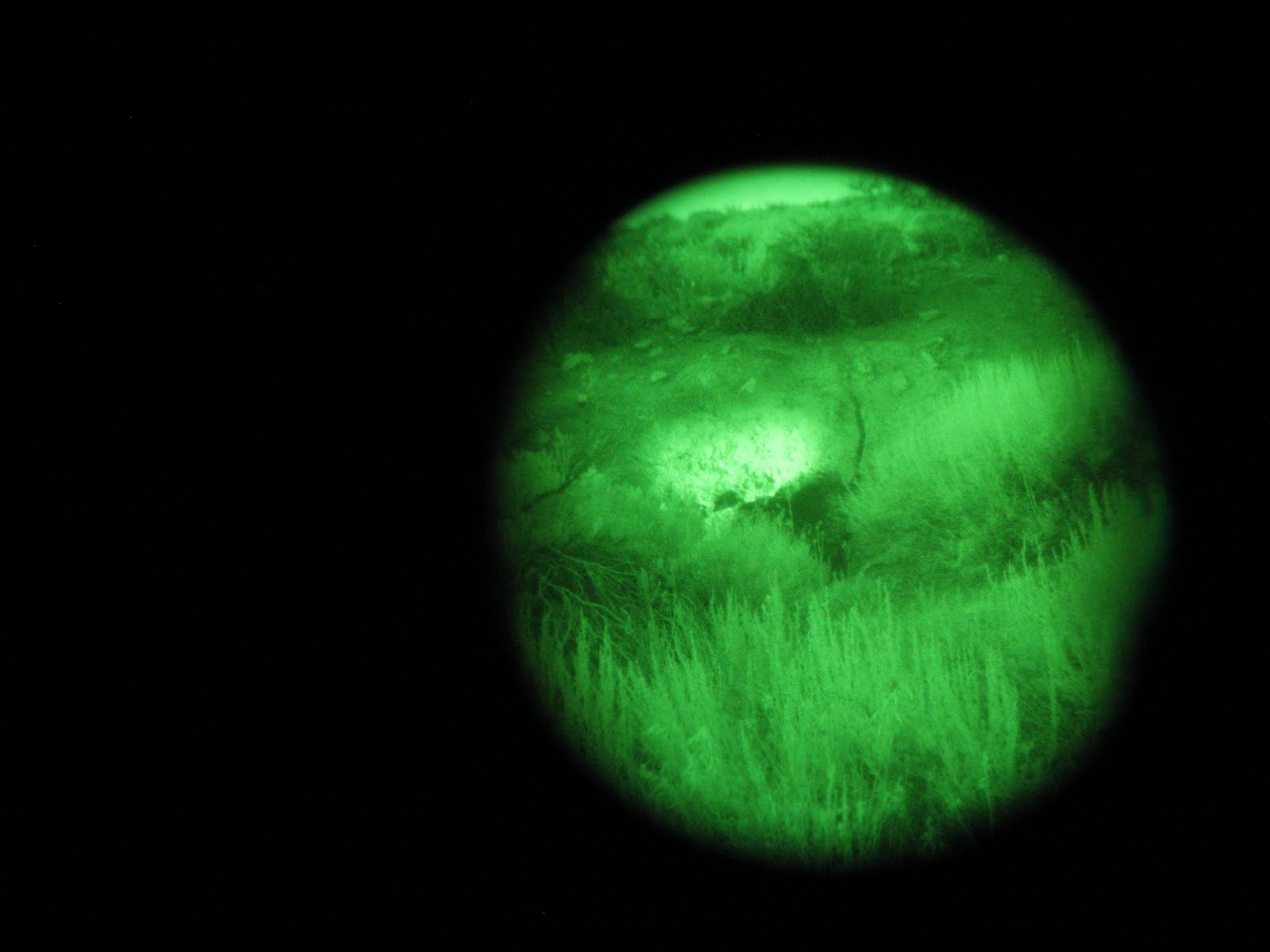
To conduct an outflight count, we position ourselves in front of each mine opening. We use an infrared light pointed towards the mine entrance and watch with night vision goggles. I have to say it feels pretty surreal to be up in some random mountains, waiting in silence with black ops gear, but it was one of my coolest experiences on the job so far. I could hear the bats' wings as they flew by my head and out into the night. Between the four of us, we ended up counting over 200 bats flying out. I had 49 from my entrance. At this time of year, this includes the babies as well as the mothers. Dr. Pat says that this is the largest Townsend's maternity colony she knows about in California.

ready to count with my night vision goggles and counter; we use two counters, one for "out" and one for "in"

okay picture through one eye of the night vision goggles, showing the infrared light illuminating the mine entrance

Townsend's big-eared bat species account by the Western Bat Working Group (pdf)