Showing posts with label botany. Show all posts

Thursday, July 28, 2011

Sorting out Sagebrush

There are numerous species of sagebrush (Artemesia sp.). They're not always easily identifiable in the field, but communities of different sagebrush species have different levels of productivity, may support different wildlife species, and respond to fire differently. So it's important for us to know which is which. A number of keys exist to assist us.


our botanist, Martin, settles down with a sagebrush and a selection of keys

Interestingly, when the leaves of different species are put into water and viewed with a UV light, they fluoresce differently. Not practical in the field, but it allows us to test our field IDs back in the office. Although sitting in a dark office lighting up tubes of sagebrush leaves does make other coworkers wonder...

The photo didn't come out as well as I hoped, but you can see that the left two tubes are fluorescing, and the rightmost isn't. Second from the right did fluoresce slightly.

from left to right: Artemesia tridentata vaseyana (mountain big sagebrush), Artemesia arbuscula (low sagebrush), Artemesia tridentata wyomingensis (Wyoming big sagebrush), Artemesia tridentata tridentata (basin big sagebrush)

Rosentreter, R. 2005. Sagebrush Identification, Ecology, and Palatability Relative to Sage-grouse. USDA Forest Service Preceedings RMRS-P-38. (pdf, external link)

Sunday, May 8, 2011

Color on the Tablelands

Wildflower season may have gotten off to a bit of a slow start, but the Volcanic Tablelands just north of Bishop are currently covered in color!


Malacothrix glabrata
desert dandelion

Mentzelia nitens
Venus blazing star

Sphaeralcea ambigua
apricot mallow

and

Chaenactis fremontii
desert pincushion

Lupinus sp. and
Malacothrix glabrata

Signs of Spring

Visiting a project site near Manzanar, we came across nesting birds and wildflowers, definitely signs of spring!

Sage Sparrow (Amphispiza belli) nest

Linanthus parryae
sand blossoms

and

Eriophyllum wallacei
wooly easterbonnets

Opuntia basilaris
beavertail cactus

Sunday, September 26, 2010

Fall Color!

Despite our unseasonably warm temperatures, fall is here and the aspen at higher elevations are changing to gorgeous colors. We took a quick drive up to Lake Sabrina and were rewarded with views of yellow, orange, red, and green patchwork on the slopes.


Fall Color Hot Spots - link to current updates by our BLM Bishop botanist

Speaking of color, we came across this impressive wasp while walking down the street in town. Best I can tell, it's Chlorion aerarium (Sphecidae), or steel-blue cricket hunter. Certainly the genus is at least correct, since she's carrying a cricket! Like the tarantula hawk I've posted a picture of previously, she'll place the paralyzed cricket in a burrow and lay an egg on it. When the larva hatches, it will feed on the still-living cricket. Creepy! The adults only feed on sap or nectar, but can give a painful sting.


Sunday, September 12, 2010

Aspen Regeneration Transects

Quaking aspen (Populus tremuloides) reproduce by clone sprouts off of their root systems. Livestock can do a number on aspen groves, browsing the young shoots (or suckers) until the root system has no energy to produce more. The adult trees eventually die out with no suckers to replace them. A number of our livestock exclusion fences protect aspen groves. To measure regeneration we survey the groves annually, counting the number of mature trees and suckers within three feet on either side of a 100-foot transect. We also measure canopy cover simply using point-intercepts, giving a percentage for the entire transect.


setting up a transect

suckers ready to be counted

Wednesday, September 1, 2010

Late Summer Seed Collecting

Today, Martin and I completed four seed collections for the Seeds of Success program. We aim for 10,000 seeds from 50 different plants for each species. Not a small undertaking. Success! Neither of us had been up to Cowtrack Mountain before, and it was absolutely beautiful. The photo below looks out over Adobe Valley between Granite Mountain (left) and Antelope Mountain (right of center).


Cercocarpus ledifolius var. intermontanus
curl-leaf mountain mahogany

itchy success!

Note: I've always found mountain mahogany to be particularly beautiful. The hair-lined extensions of the fruits glow in daylight, giving the entire plant a soft haloed appearance. Well, today I found out that those pretty little hairs are like fiberglass. I'm not sure I can ever look at the plant in the same way again...


hopefully viable success!

Leymus cinereus
Great Basin wild rye

Erioganum umbellatum
sulfur flower

umbellievable success!

delirious success!

Grayia spinosa
spiny hop-sage

Changing Seasons...

Most of the wildflowers in the Eastern Sierra have finished, but now the shrubs are having their turn to show off! The sagebrush (Artemisia tridentata, various subspecies) aren't too impressive, but the bright rabbitbrush (Chrysothamnus nauseosus and C. viscidiflorus, various subspecies) adds splashes of yellow across the landscape.


sagebrush trying its best


bumble-bee on rabbitbrush
(that I failed to key, grr)


How cool is this spider web?! In the middle is a decorated funnel that appeared to open at the bottom. Any spider-pals have insights?

Now I'm just waiting for the aspens to start changing...

Sunday, July 18, 2010

Tuolomne Meadows, Yosemite National Park

I visited Tuolomne Meadows for the first time, entering Yosemite from the east. Even right along Tioga Road the meadows were beautiful, filled with patches of differently colored wildflowers. Most striking were the pale pink swathes of Dodecatheon jeffreyi (Jeffrey's shooting-star).

We took a hike to Elizabeth Lake, below Unicorn Peak, 4.8 miles round-trip with 1000' elevation gain. Although we started at 8600', it was still warm and unseasonably humid, making it difficult to catch our breath. I hadn't thought about it before; humidity may make the air feel more dense, but since water is displacing air the density of air is actually thinner. Because it got cooler and less humid as we went higher, it actually got easier to breathe. Weird !

The trail passes through a forest of lodgepole pine and mountain hemlock, alongside and crossing small streams. As the topography flattens out, the ground is wetter, supporting lush green groundcover...and mosquitoes ! Entering the meadow surrounding Elizabeth Lake, the little buggers were intolerable. We quickly wound our way to the lake's edge, snapped a few pictures, and retreated down to a lower and drier spot for our lunch of Schat's sandwiches. I highly recommend the turkey salad !

Birds were the usual suspects: dark-eyed junco, western wood-pewee, Steller's jay, American robin, brown creeper, yellow-throated warbler, mountain chickadee, Cassin's finch. But we did experience some neat behavior moments ! First, a junco snatched up an insect from a tree trunk just a couple feet in front of us. I guess the tastiness of the snack outweighed our proximity. In the trees above, I was hearing a call that didn't sound quite familiar... it turned out to be a very demanding fledgling yellow-rumped warbler. We watched for a while as its tireless parents flitted around and returned with morsels for their obnoxious offspring. Still, it was kinda cute...


Lupinus breweri
Brewer's lupine

Triteleia ixioides
pretty face

Castilleja lemmonii
subalpine paintbrush
(with buddy !)

Elizabeth Lake beneath Unicorn Peak


Dodecatheon jeffreyi
Jeffrey's shooting-star

Lembert Dome from Tuolomne Meadow

Half Dome from Olmsted Point

Tenaya Lake from Olmsted Point

Wednesday, July 14, 2010

Seeds of Success

"Convince me that you have seed there, and I am prepared to expect wonders." - Henry David Thoreau

In cooperation with other agencies, municipalities, and botanic gardens, BLM coordinates the Seeds of Success (SOS) program. SOS was established to collect and conserve native plant seeds. Seed collections are either held for conservation or used in restoration and research projects. Seeds are collected when and where the plants are abundant.

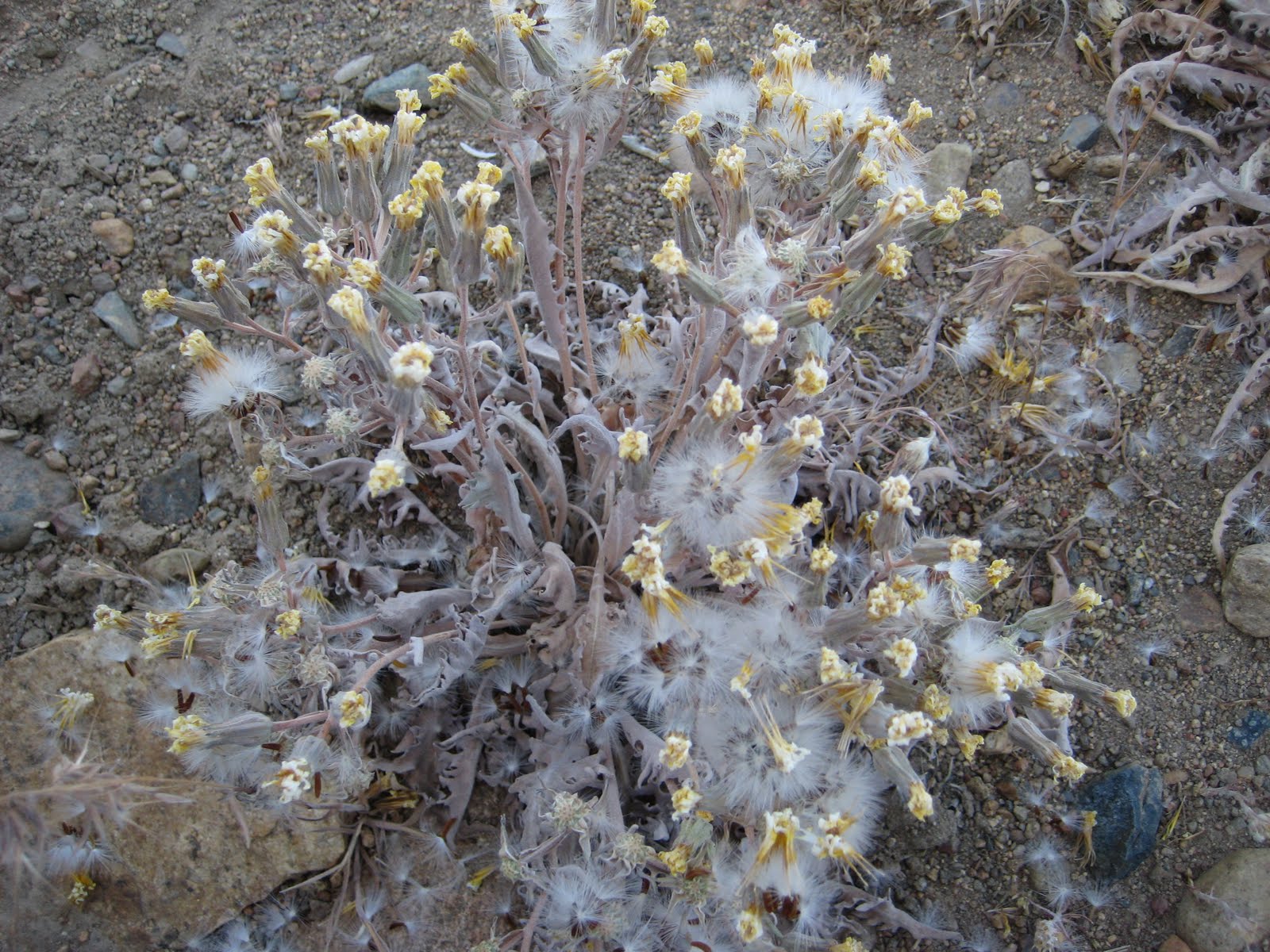
Yesterday, I helped Martin collect the seeds of Crepis occidentalis (western hawk's-beard). The unassuming plant, looking not too unlike a common dandelion, is apparently quite tasty to sage-grouse. While the grouse can and do eat sagebrush, the chicks start off on insects and forbs in the spring and early summer. We'll be able to use the seeds for restoration in the event of a fire.

Seeds of Success Program


Crepis occidentalis
gone to seed

success !

I started my day doing the second willow flycatcher survey at Dogtown. Still no WIFLs, but here are a couple pictures of other cool stuff.


Sidalcea oregana
bog mallow


spotted towhee nest

I would like to thank Mr. and Mrs. Towhee for allowing me to snap the quick picture of their babies. They were awfully mad at me, but I couldn't resist...their little ones are so cute !!!

Incidentally, I just learned that a group of towhees is a "tangle" or a "teapot". You learn something new every day !
Sunday, July 11, 2010

Sabrina Basin, John Muir Wilderness

"I only went out for a walk and finally concluded to stay out until sundown, for going out, I found, was really going in." - John Muir

So reads the sign at the Sabrina Basin trailhead that leads into the John Muir Wilderness of the Inyo National Forest, a 20 minute drive up my street. Brent and I headed out on the trail for a single night backpacking trip. The trail begins just below the Lake Sabrina dam at 9,125' elevation and follows the lake through aspen and willows, becoming sagebrush scrub dotted with conifers and covered with wildflowers this time of year. Continuing higher, you pass through lodgepole pine forest and the trail steepens with switchbacks cut into the granite. We finally reached Blue Lake, only 3 miles in but at 10,400', had lunch, and decided to set up camp there. After a refreshing nap, we set out much lighter and followed a trail to Emerald Lakes, giving us stunning views of the peaks surrounding the Basin and more alpine wildflowers.

We spent a nice evening at camp alongside Blue Lake, enjoying dinner and swatting mosquitoes. It rained in the night, making the extra weight of our tent fly worthwhile. After breakfast, we headed back down the trail, much easier in this direction and minus three meals. We plan to return, probably as a day hike, and explore more of the lakes deeper into Sabrina Basin.


Aquilegia pubescens
alpine columbine


Aquilegia formosa x
Aquilegia pubescens


Sedum lanceolatum
narrow-leaf stonecrop

Castilleja linariifolia
long-leaved paintbrush

crossing Lake George's outlet


lodgepole chipmunk (Tamias speciosus) shows the way


golden-mantled ground squirrel
Spermophilus lateralis, SPELAT

Phyllodoce breweri
red heather

Mt. Haeckel from Emerald Lakes


yellow-bellied marmot
Marmota flaviventris

Thompson Ridge, Blue Lake

clouds reflected in Blue Lake

Bird list: song sparrow, yellow warbler, brown-headed cowbird, dark-eyed junco, mountain chickadee, Clark's nutcracker, red-breasted sapsucker, brown creeper, Cassin's finch, dusky flycatcher, yellow-rumped warbler, golden eagle, Steller's jay, western wood pewee, olive-sided flycatcher, northern flicker.

More pictures are available here. Enjoy !